Overstriding
Where your foot lands relative to your body
Overstriding is when your foot touches down well ahead of your body. Runify Motion measures it from the angle of your shin at the moment of contact, for every foot contact in your video and for each foot.
Reliable measure: it has a score and, when it helps, something to try.
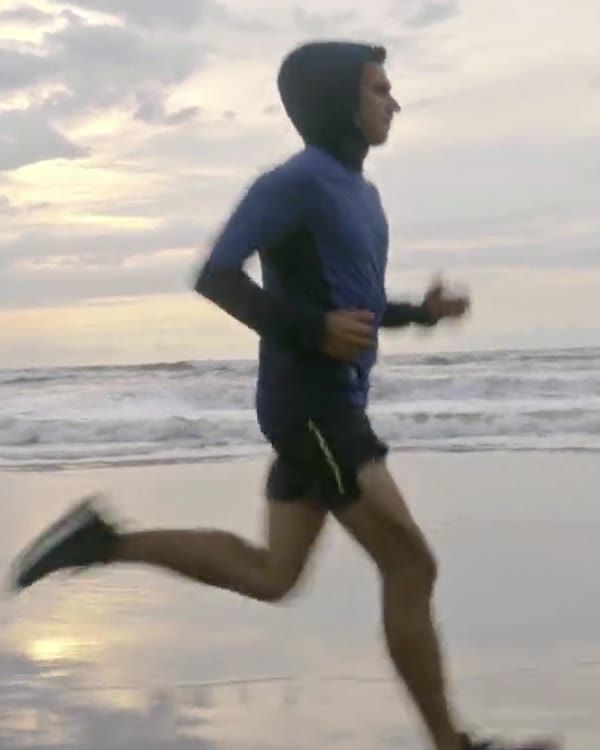
Initial contact: the shin as the foot touches down
How to read the value
0° means a vertical shin, with the foot under the knee; the higher the value, the farther ahead of your body the foot lands. A negative value means the foot lands slightly behind the knee.
In the detail view the app puts it in a sentence: the foot touches down “slightly behind the knee” below 0°, “almost under the knee” up to 2.5°, “just ahead of the knee” up to 8°, “ahead of the knee” above that. If both feet fall in the same range it writes “Both feet…”
With at least four steps the app also looks at which foot lands farther forward on each step, for example: “In 6 of 7 steps, the right foot lands farther forward than the left.”
What it can mean
A foot that lands well ahead of the body is associated with more braking at every foot contact. There’s no right angle for everyone: the value describes how you run today.
It’s also the measure most tied to speed and terrain: the same runner can get different values on a flat straight and on a gentle uphill.
Studies: Heiderscheit 2011; Lieberman 2015.
To measure it well
To compare two analyses, record at the same speed with the camera in the same spot: where your foot lands changes a lot with pace.
The moment your foot touches down is very short: record at 60 frames per second or more. Below 60 fps the app flags it and the values at contact become approximate.
Keep your feet inside the frame: overstriding is measured from the foot, and if it leaves the frame the app suggests nothing.
What the app suggests
When the measure is reliable and the score isn’t in the top band, the app can suggest gait retraining in the Try this tab: “Slightly higher cadence,” slightly quicker steps at the same speed, for 5 + 5 minutes.
Start at +5%; go up to +7.5% only if you don’t feel a difference. What to watch for: your step should get shorter and your foot should land closer to your body, without much more effort. There’s no cadence that fits everyone, and don’t add running volume at the same time.
Raising cadence by 5–10% at the same speed shortens the step and brings the foot closer to the body: the immediate effect is backed by several studies (Heiderscheit 2011; Lenhart 2014; Lieberman 2015; Schubert 2014 review), the evidence that it lasts is weaker (Willy 2016; Bramah 2019).
Before suggesting it, the app asks whether you have pain, a recent injury or symptoms while running. If you answer yes, it suggests no changes and recommends seeing a professional. Your answer stays on the phone.